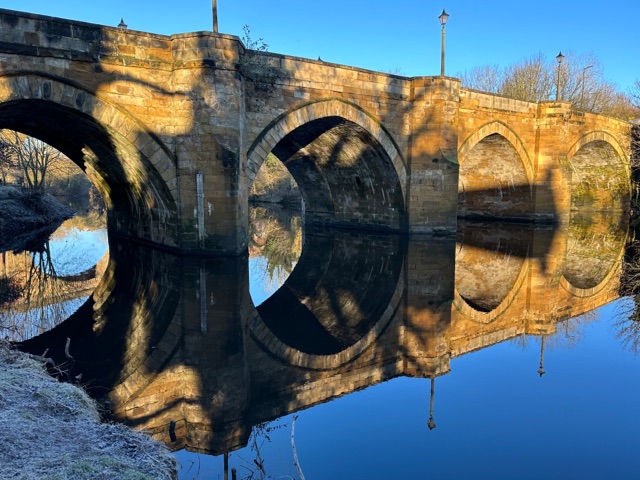
We’ve lived in Yarm for 40 years. It’s a border town on the south bank of the River Tees, in what used to be the North Riding of Yorkshire. Egglescliffe, on the north bank of the river, was part of County Durham. In medieval times you had to pay a toll to cross the bridge. Walter Skirlaw, Prince-Bishop of Durham built the bridge around 1400AD, replacing a 200 year-old timber bridge. In the 1640s during the English Civil War, the north arch of the bridge was replaced with a wooden drawbridge, to prevent Parliamentary forces crossing to attack the Royalists in Durham. The Vicar of Egglescliffe was given control of the drawbridge, which remained in place until 1785 when the stone arch was rebuilt.
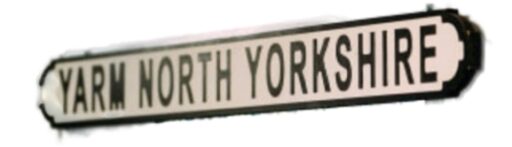
This brief history illustrates the importance of the Tees as a border, and Yarm as a crossing-point, but border country is debatable land. I was appalled at the historic vandalism of Edward Heath’s government, which tore up centuries of community tradition when it reorganised county boundaries, even abolishing some ancient counties and creating new ones. Yarm is no longer part of Yorkshire, and Egglescliffe is not in Country Durham. They are part of the “Borough of Stockton-on-Tees Unitary Authority”. Alas, there is no Cumberland or Westmorland now, and the Ridings of Yorkshire are a thing of the past. “Stockton-on Tees Unitary Authority” doesn’t have the same ring to it as “North Riding of Yorkshire”, nor, for that matter does “North Yorkshire”. Some traditional county names and boundaries are retained for “ceremonial purposes”, whatever that means. But I suspect this sop was offered because of the huge opposition to the changes. Place names are a significant part of community and sense of belonging. In a 2014 referendum, 89% of Yarm residents voted to leave Stockton and join North Yorkshire. Predictably, this was ignored by Stockton Council, but some residents have attached a plaque to their house wall saying “Yarm, North Yorkshire”.
Political tinkering with location names can be confusing for identifying addresses, and some online address forms still require a county name where none exists. For hundreds of years Middlesbrough was in the North Riding of Yorkshire, then in 1968 became part of the County Borough of Teesside. In 1974, Teesside was abolished and Middlesbrough was placed in the newly created county of Cleveland. Cleveland County was abolished in 1996, and Middlesbrough was made a unitary authority, within the ceremonial county of North Yorkshire. Confused? So am I. Visiting foreigners must scratch their head in bemusement.
You’ve probably guessed where I’m going with this. There are boundaries in life other than land, infinitely more important. The county changes are merely annoying but other kinds of boundary shifting can be catastrophic. What about the boundaries of honesty and integrity? Or decency in disagreement? What happens when we move the fences of tolerance and kindliness? What happens when wrong and right get mixed up? Where do we go if love has limits that move with time? The Bible says “Wo unto them that call evil good, and good evil, that put darkness for light and light for darkness, that put bitter for sweet and sweet for bitter.” (Isaiah 5:20) That quote seems timely for our day in politics, commercial transactions, news agencies, moral behaviour, in fact all relationships between people. The big question for each of us is: are my boundaries “debatable land”?
In a changeable world with shifting boundaries, the unchangeable standards of Christ are a fixed anchor. Mormon testifies: “For I know that God is not a partial God, neither a changeable being; but he is unchangeable from all eternity to all eternity.” (Moroni 8:18) The scriptures have hundreds of references saying the same thing. God will always be fair, always trustworthy, always dependable, always supportive. His patience and love for us is eternal. No moving borders, no debatable land here. One of the joys of the Gospel of Jesus Christ is the security of unchanging truth, a settled oasis of peace in a turbulent world. Over the ages men have done their best to twist and warp it for their own ends, but the truths taught by Jesus 2,000 years ago are the same as those taught by apostles in his restored church today, and they belong in every county and borough, old and new.